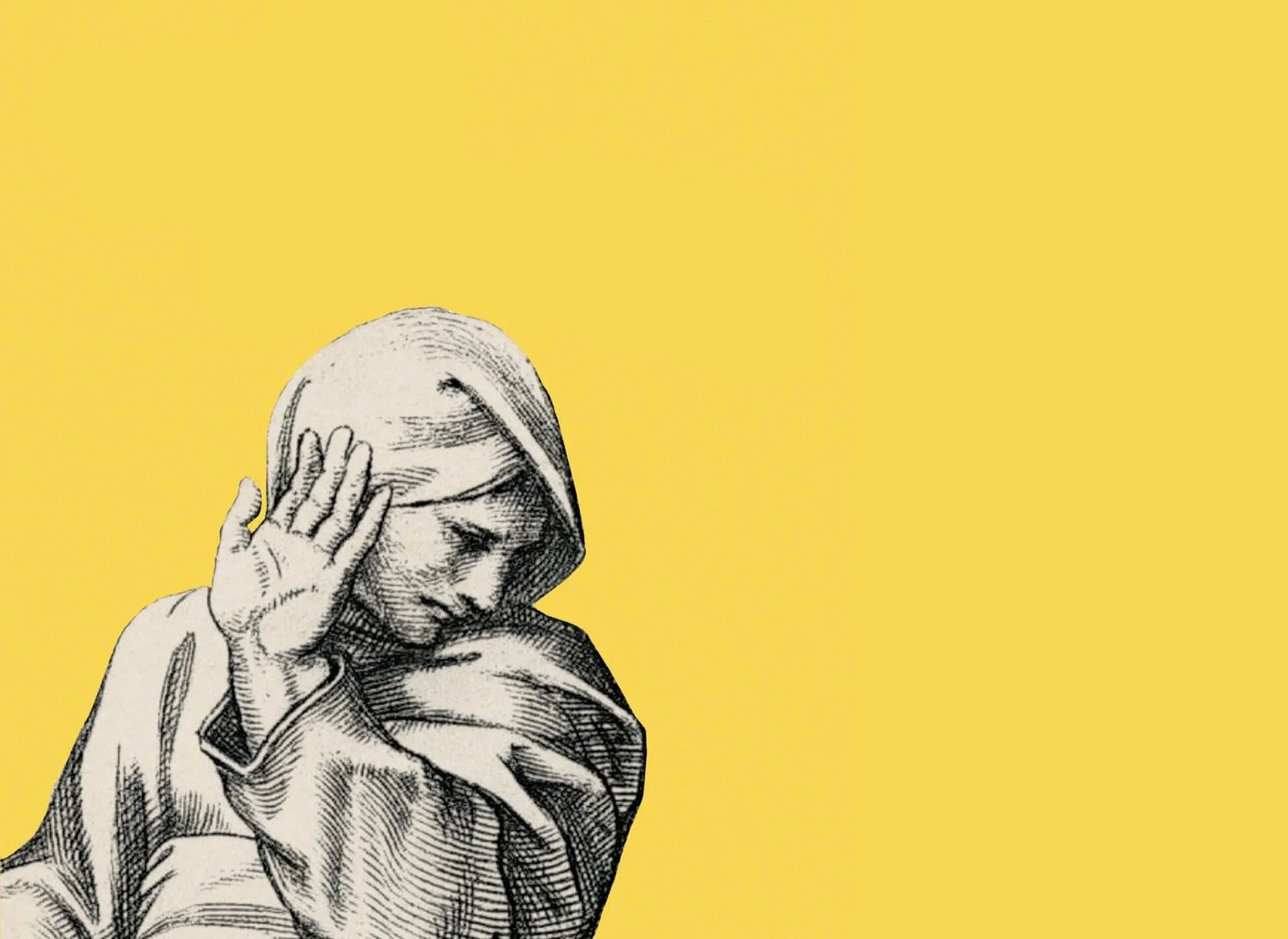
There they were,
standing naked,
facing one another, covering their eyes with their hands. . . .
Prologue
There they were, standing naked, facing one another, covering their eyes with their hands. When I first happened upon this image of Adam and Eve drawn into the pages of a manuscript more than a thousand years ago, it seemed deeply familiar in some strange way. Strange, I thought, because the fallen couple typically covers their genitals, not their eyes. As I puzzled over their gesture, I came to realize that it must convey some fundamental consequence of their eyes suddenly being forced open: et aperti sunt oculi. By eating the forbidden fruit, their eyes were opened to the knowledge of good and evil, to their sexual bodies, to the reality of death and all its attendant grief. Their eyes were opened to the pains of this world. They now needed a way to turn away.
As I had this realization and began to write this book, the pains of this world—the world I had begun to bring my own children into—were feeling heavier than ever. The photograph of Aylan Kurdi, a three-year-old Syrian boy washed up on a Turkish beach, brought sudden global attention to a cruel war and the ongoing refugee crisis. Just as soon as the world was roused to attention, debates reignited about the role of such images in the media. Comparisons were made to the 1972 photograph of children fleeing an American napalm strike in Vietnam, which had provoked a similar reckoning. Even before this now infamous image circulated, the German filmmaker Harun Farocki had presciently worried: “If we show you pictures of napalm damage, you’ll close your eyes. First you’ll close your eyes to the pictures; then you’ll close your eyes to the memory; then you’ll close your eyes to the facts; then you’ll close your eyes to the connections between them. If we show you a person with napalm burns, we’ll hurt your feelings.” To a different end, so too worried the head of The Guardian’s media desk decades later, explaining their decision to print a different image by noting with similar language that the one of the boy lying face down on the beach “was too upsetting.” They reasoned that by “just showing a dead child, the effect would be to make [readers] withdraw from the story.” A few days later, when NPR published an article about these and other media responses, it featured not the image of the child but a photograph of his father with his hand covering his face.
This book began in the confluence of these two streams of life. I wondered, What is at stake in this kind of gesture? What is its history? And how does that history refract into our own tendencies to turn away when faced with the suffering of others? It is a tendency now widely, if not universally, condemned. We live in the hum of a constant refrain not to look away. “All eyes on Rafah” comes immediately to mind: a viral product of a pervasive logic. An article by two social scientists in Scientific American announces that “we’ve hit peak denial” and explains that now is not the time to “turn away.” Meanwhile, The Onion ends an article on the war in Gaza with a satirical lesson: “Or, you know, that it might be easier to just look away.”
This is the refrain to the song of the twentieth-and twenty-first centuries, in which one of the only guardrails against atrocity would seem to be public attention: how such atrocities persist on account of the public’s habituated unwillingness to look, our malignant ignorance, our disinterest, our nihilism. “How many times can a man turn his head,” sings Bob Dylan, “pretending he just doesn’t see?”
Some contemporary art urges its publics not to look away as a nonviolent guardrail against violence, while films like Lee (2023) and The Zone of Interest (2023) remind us how easily such guardrails fail to hold. And in today’s economy of attention, this refrain (or some variation of “Don’t turn away!”) only seems to feed our doomscrolling addictions. So quickly and thoughtlessly we turn from one atrocity to the next.
Attention has become a moral currency. But it’s easily a spurious one. Think of the two young couples in The White Lotus (2021), drinking their Aperol spritzes alfresco at a cliffside hotel in Sicily. Having located her Ambien, Harper is surprised by the other couple’s apparent unawareness of “everything that’s going on.” What’s keeping her awake at night? “Oh, I don’t know, just, like, the end of the world,” she says, as the other couple laughs, casually confessing to not watching the news any more. Then they order another round of spritzes and all go for a swim. An implicit critique hangs over this awkward scene: There’s not all that much difference between the one couple who stays up at night worrying about “all that’s going on in the world” and the other who can no longer bother to pay attention. It’s a critique that subtly resonates with a detail in the show’s opening credits. The sequence of faux frescoes depicting ancient-looking scenes of sexual lust hint at the season’s overarching theme. As the eerily catchy theme song (“Renaissance” by Cristobal Tapia de Veer) transitions into a techno dance beat, we are shown a painting of a cliffside villa burning. Smoke billows into the air. A quick pan down to find a man on the beach looking out to the ships at sea, perhaps headed for disaster. Then another even faster pan to the side where two people are engaged in fellatio. All while the world burns.
It’s just another variation on W. H. Auden’s “Musée des Beaux Arts” (1938):
About suffering they were never wrong,
The Old Masters: how well they understood
Its human position; how it takes place
While someone else is eating or opening a window or just walking dully along.
What a privilege it is to be able to have sex or drink spritzes while the world goes up in flames (“how everything turns away / Quite leisurely from the disaster”). Indeed, what a gross privilege it is to do so not far from the Turkish beach on which Aylan Kurdi washed ashore.
Here, we couldn’t be further from his father, standing in a photograph with his face in his hand. In a sense, Mr. Kurdi is turning away. But his gesture is also the gesture of a father’s unbearable grief. It may be a privilege to turn away. But not all turning away is a privilege. Back in Syria, in the final scene of Feras Fayyad’s documentary The Cave (2019), the tireless Dr. Amani Ballour is forced to evacuate her underground hospital in Ghouta after ever-escalating destruction. On the journey to safety, she closes her eyes in a rare moment of reprieve and reflects in what feels like a poetic voice: “I’m afraid to open my eyes. I’m afraid that what I saw will haunt me forever.”
But why is it that I close my eyes? Why do I turn away? In this gesture, I become a question to myself. And as I become a question to myself, the horizon of my present meets the horizon of the past.
Gestures of aversion (from Latin avertere, “to turn away”) might seem to repudiate the very possibility for ethical connection. They might seem like a refusal to address and attend to the world of others. But when these gestures show up in the art, literature, and philosophy of the past two millennia, they tell a different story. Far from nihilism or acquiescence, militant ignorance or casual disinterest, turning away can sometimes be one of the most profound and necessary forms of engagement. It is a gesture deeply embedded in the experience of being human. It is how we think and question, how we grieve and show respect, how we respond to others and fall into moral distress, how we fear, how we go mad.
Perhaps, as attention has become ever more of an addictive substance, we seek out philosophical justifications for our reluctance to turn away. Or perhaps the dabbing youth are onto something, with a cool cultural response to the imperative to constantly look. Gestures of aversion permeate and mediate so much of our visual culture. And rather than condemning my act of turning away, these historical iterations provoke me to ask a more potent question: Why am I turning away? This question, I believe, is a prerequisite for any meaningful political discourse (from Latin dis-, “away,” and currere, “to run”). It is the basis for our ethical orientations in the world, whether we like it or not. It implies that turning away is a process that never fully completes. It never fully eliminates the thing seen, the thing that provoked the turn in the first place, the thing that will haunt us forever.
What follows is an attempt to bring the past to bear on the broader question of why we turn away. Since this is also inevitably a personal question, I have found myself writing in a voice somewhat analogous to the chorus of a Greek tragedy. As both observer and participant, the chorus offers a lyrical link between the audience and the actors, between the intellect and the body. The stasima, or choral odes interspersed through the course of a play are theoretical and gestural. They are theoretical in the etymological sense of theoria (Greek for “looking at, viewing, beholding”) and in the sense of spectatorship implicit in the theatricality of the stage. They are gestural in the etymological sense of gerere (Latin for “to carry, to bear”) and in the sense that they are accompanied by movements of the body that we call dance. So too am I a spectator and a vessel. And in this mixed voice, I have choreographed the five chapters that follow. To keep the analogy going, we could call these chapters stasima. Or we could just call them essays. Or perhaps the chorus is, in fact, a precedent for the literary form of the essay itself, and it is in that transhistorical tradition that I write. Either way, this is a book that necessarily proceeds from my own intellectual observations and embodied orientations, limited and wavering, turning this way and that, encountering works of art here or feeling discomforted there by yet another difficult or painful sight.
The first chapter, titled “Parados,” is so named after the entry of the chorus and the opening choral song. In part, it offers some initial framing and sets out the stakes for the book as a whole. But it is also a reflection on how this gesture of turning away leads you in through its suggestiveness, how it incites your imagination by means of its withholding. In this spirit, I have given each of the subsequent chapters, or stasima, a title that is deliberately more evocative than descriptive: “Ambivalence,” “Sensation,” “Darkness,” “Retroversion.”
One of the realizations that I have had in writing this book is that these gestures (which I try to enclose within the insufficient category of aversion) belong to an idiom that does not want to be apprehended directly. The conceptual evocations of these chapters are thus meant to give you something like a “matrix of the dialogue” (to borrow a phrase from Nietzsche and his description of the chorus in The Birth of Tragedy). An initial sense of the characters in dialogue can be glimpsed at the start of each chapter, where you will find something like an abbreviated list of dramatis personae. Some of these figures recur across several chapters. Others appear only briefly. These headings foreshadow some of the admittedly unpredictable twists and turns and characters involved in each chapter, threaded together sometimes only by a fleeting use of this ancient gesture.
The chorus is also a collective voice. And in that spirit, I hope we may together waver and dance among these variations of an ancient gesture, turning our attention this way and that. As I gesticulate for you to notice what I have noticed, I invite you to allow your own patterns and habits of attention to be arrested along the way.
order your copy or cover your eyes
-
“This is a book that makes a difference, not only in our grasp of human visuality but in all the mixed feelings of love and hate, attraction and repulsion, thought and feeling that make us the crazy animals we are.”
- W. J. T. Mitchell, author of What Do Pictures Want?
-
“Endlessly rich, and as imaginative as it is scholarly, TURNING AWAY gives us startlingly new insights into a fascinatingly negative gesture.”
— Sianne Ngai, author of Ugly Feelings
-
“Composed with an electric blend of writerly elegance and moral urgency, this erudite book compels its readers to keep our eyes fixed on its pages.”
—Marta Figlerowicz, author of Spaces of Feeling: Affect and Awareness in Modernist Literature
-
“This lavish and virtuosic book finds in the gesture of turning away an entire history of why we turn to art to understand what we cannot look at directly.”
—D. Vance Smith, author of Atlas’s Bones